 Our morning routine often involves a shot of caffeine and during the day, whatever the reasons, we may need it again (and again) for an instant boost. But too much caffeine may cause an unpleasant nervousness. That's why Nestlé is looking for a way for the caffeine to be released more constantly rather than in one batch. To achieve this, Nestlé Research Center Lausanne's scientists are collaborating with the EPFL's (Ecole Polytechnique Fédérale de Lausanne) Interdisciplinary Centre for Electron Microscopy and EPFL's Institute of Cancer Research, as well as the Department of Health Science & Technology of ETH (Swiss Federal Institute of Technology) Zurich.
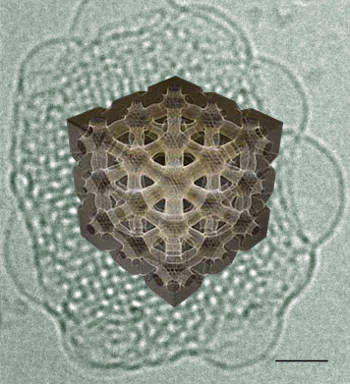
And they just discovered a technique that "can 'see' inside dispersed cubosomes (dispersed cubic liquid crystalline phases) with unprecedented detail. The breakthrough can help to improve their design significantly for better drug or nutrient delivery", as the EPFL explains, these cubosomes being “small biological 'capsules' that can deliver molecules of nutrients or drugs with high efficiency. This also means that cubosomes are safe to use in living organisms."
The aim is now to see how it is possible to use the cubosome's structure to deliver nutrients, medication or, precisely, caffeine, in a controlled and safe fashion. So, one day may be, we won't need more than just one cup of coffee in the morning, and still benefit from its boost all through the day.
Photo: 3D reconstruction of a cubosome obtained with CET. Scale bar: 40 nm ©Davide Demurtas/EPFL
News in the same category
Previously Samsung offered pop-up shops around the US that were focused on letting customers experience the brand's products and technology.
If you can't even find the time to sit a few minutes for a much-needed caffeine shot, inhalation may be the solution. Actually, it's becoming very trendy.
The state of Ohio is famous for its excellent range of coffee shops, which range from traditional and rather sedate to the fresh and funky.
Several salmonella cases have being recently reported in three states, triggering the recall of more than 3m pounds of frozen chicken products from Barber Foods and Aspen Foods.