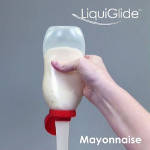
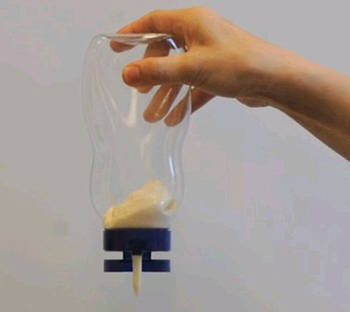
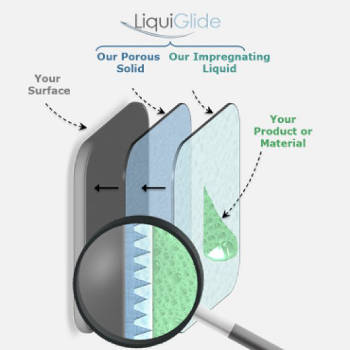
 LiquiGlide was created three years ago to market a revolutionary MIT invention: a patented liquid-impregnated surface technology. "A liquid-impregnated surface is a multi-layer surface, consisting of a customized solid texture and a liquid. The highly textured solid surface is composed of a matrix of features spaced sufficiently close to stably contain the impregnating liquid that fills in the spaces between the features. The liquid is held in place within the texture, creating a permanently slippery, liquid surface. The product is actually sliding on our liquid layer, in a liquid-to-liquid interface." That's how LiquiGlide explains the concept, and if it sounds a bit obscure, their various videos demonstrate how effective this is.
 Each coating is developed according to the liquid's specifics, whether it's glue, toothpaste, nail enamel... or ketchup and mayonnaise. Orkla, a Norwegian food manufacturer, announced last week their agreement with LiquiGlide to use their technology for mayonnaise products in Northern Europe. One may be concerned about the slippery coating's risks on health, but LiquiGlide confirms that each coating can be made from food and is designed to be harmless and to meet all the required safety standards. Hopefully many food and grocery manufacturer will follow and allow us to enjoy our mayonnaise to the very last drop.
Photos: LiquiGlide / MIT
News in the same category
Disney's Playmation toys are actually beyond toys. Wearables, motion sensors, wireless technology amongst others, will allow your kids to be a real part of the story, in a way that's really innovative. Welcome to a new smart toys era.
At this pace, we may end choosing our smartphone on the basis of the payment solution it offers. Here's the latest: Samsung Pay.
Adidas introduced a revolutionary swimsuit last month in Germany. According to them, the Adizero XVI swimsuit is the fastest ever.
This year's New York Toy Fair gave Mattel the opportunity to unveil a completely redesigned version of their famous ThingMaker. Definitely looking forward to Christmas.